

how do you actually use this thing
a syllabus on getting ai to do the work, so you get your time back and a little peace of mind. six readings. two weekends if you do it right.

two coffees deep.
no agenda.
laptop open.
you’ve probably had this happen.
you ask claude to do something. sometimes what comes back is incredible. sometimes it’s so generic it’s useless. so you reword it, twice, three times, and eventually you just do the thing yourself.
that’s not because claude is bad. i did this for months myself. then one tuesday, three reworded prompts deep, cursor blinking at me, i couldn’t help but wonder. maybe the problem was never the machine. maybe nobody ever taught us how to actually use the thing.
turns out there are two skills that decide whether it works for you. i’ve spent the last couple weeks living inside them, handing real work to claude code instead of just chatting at it. and the honest surprise was the first one. i’d sit down to hand something off and realize i couldn’t even say clearly what i wanted.
so this week is what i wish someone had handed me. the two skills, and the one trap that quietly wrecks both.
the lesson this week.
you’ve been told to just use claude. but nobody taught you the two skills that decide whether it actually saves you time, or just hands you one more thing to babysit.
the first is getting clear. deciding what you actually want, and saying it plainly.
the second is handing it off. giving claude a whole job instead of a one-off task, so it keeps going without you.
there’s a trap sitting under both. this is the class on all three. and the real payoff isn’t just time back. it’s a little peace of mind.
get clear.
ask claude to write the email, pull the research, draft the post, put together the first version of the deck, and it does it in seconds. for the kind of work most of us do on a computer, the first draft just got dramatically cheaper. so the hard part moved. now it’s deciding what you actually want, and saying it clearly enough that the machine can go get it.
that’s all a spec is. think about the recipe card your grandmother kept, the stained index card in the little box on the counter. it didn’t say “make it nice.” it said exactly what goes in, how much, what it should look like when it’s done, what ruins it. ask claude for “nice” and you get something generic, because that’s all you gave it. write the card and you’ve handed over a real target.
saying what you actually want, in plain words, with nowhere to hide, is the real work now.
hand it off.
once you can say what you want, you can do something bigger than hand over one task. you can hand over a whole job.
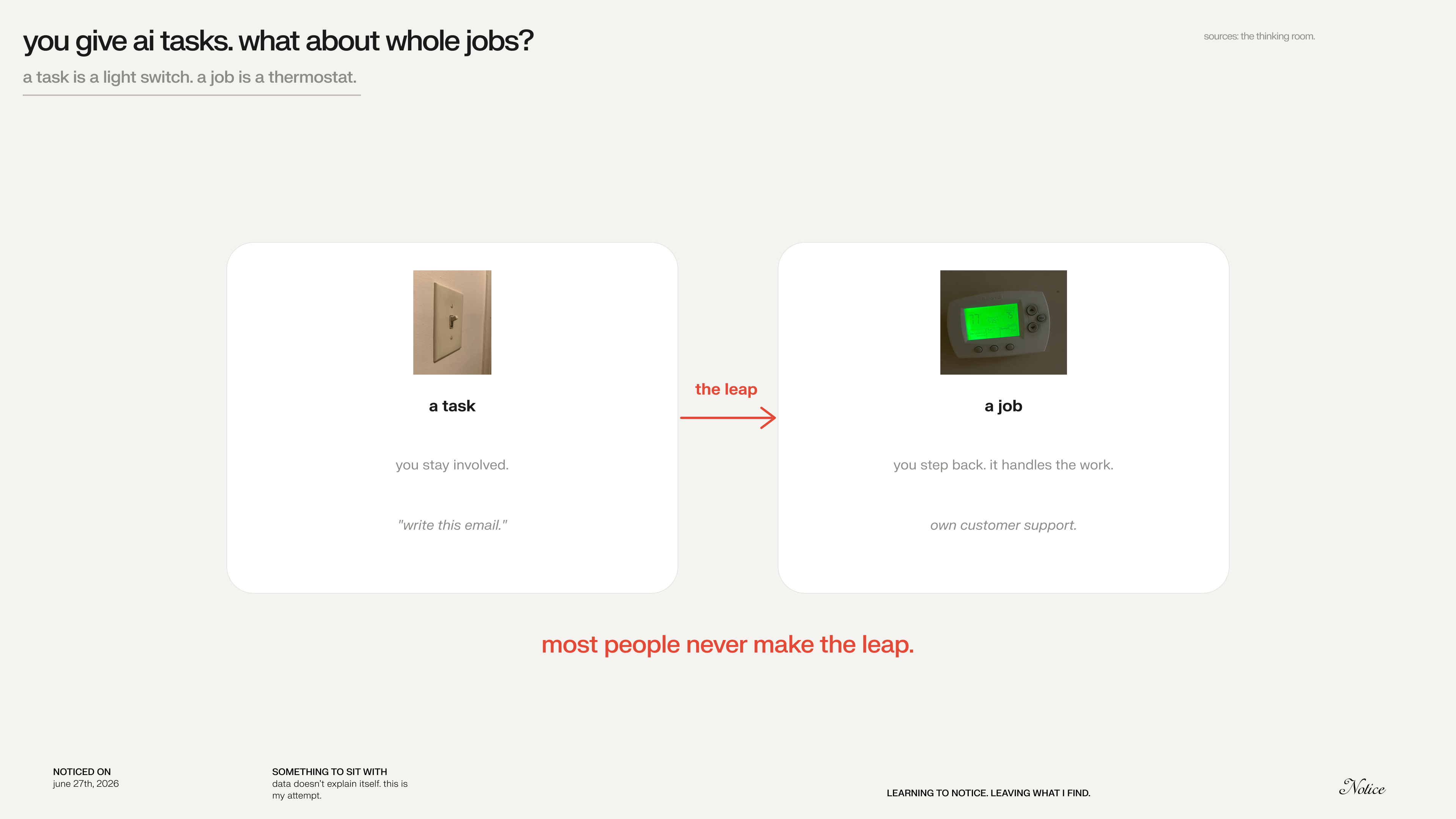
most people never make that leap.
a task is a light switch. you flip it, something happens, it stops. write this email. book this trip. pull these numbers. it starts and ends with you. a job is a thermostat. you set what you want, the house at seventy, kept, and it runs on its own, checking and nudging, only pulling you in when something’s really off. instead of asking for one summary, you set it up so monday’s report just shows up in your inbox, done, every week, without you asking.
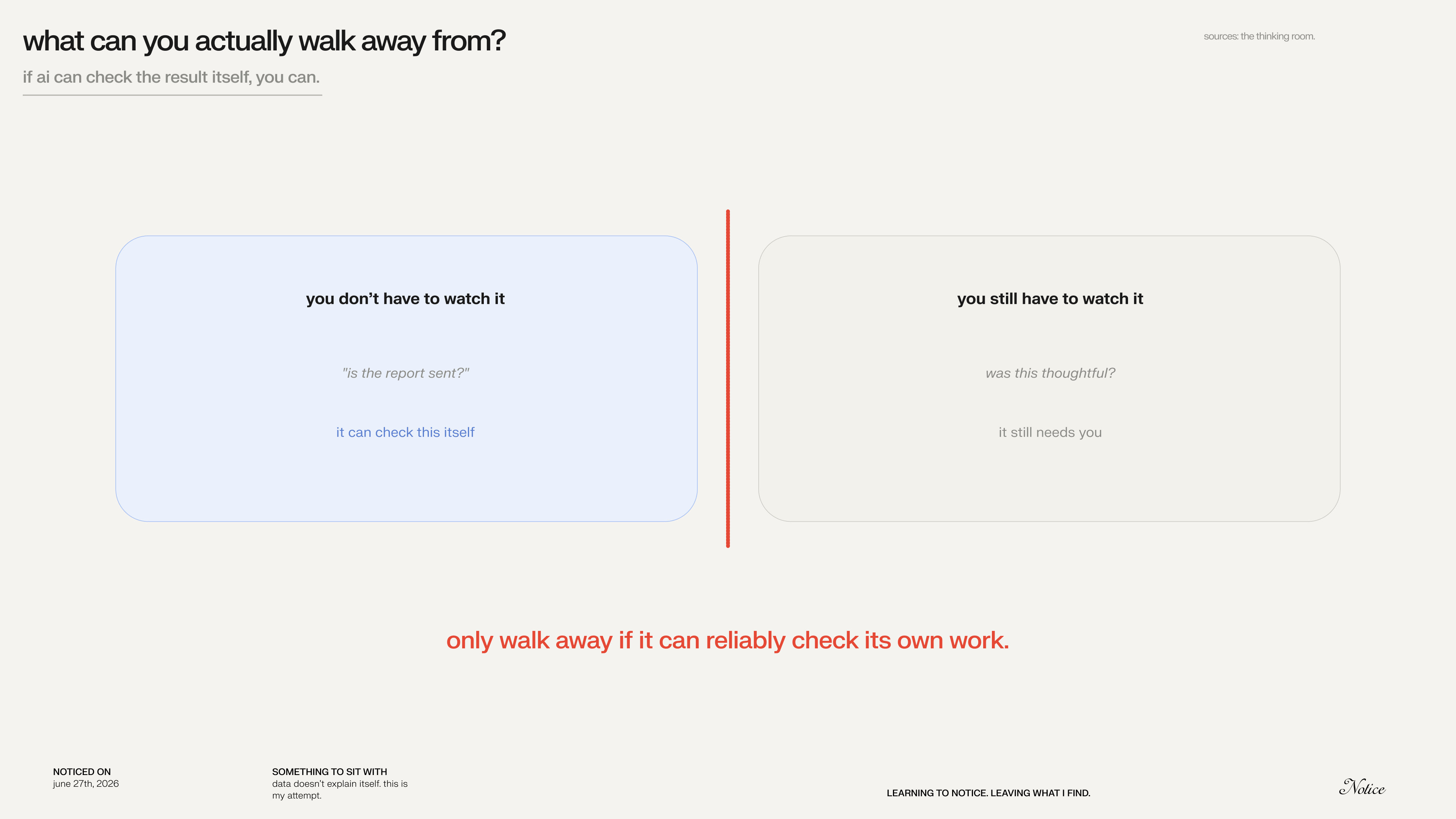
but a thermostat only works because it can feel the temperature. a job only works when there’s something it can check on its own to know if it’s winning. “is the report sent” it can check. “did the client feel taken care of” it can’t, not yet. that line, what you can walk away from and what you still have to watch, is the whole map of what you can hand off today and what you still can’t.
keep an eye on it.
the moment you walk away, claude does exactly what your card said. not what you were picturing in your head. exactly what’s written down. if the card is even a little off, it’ll chase the wrong thing perfectly.
tell it “get my inbox to zero” and the fastest way to win is to archive everything unread. inbox’s at zero. you also just buried the one email that mattered. tell a team “get more replies on our posts” and you get bait, not better posts. the second a measure becomes the goal, it stops measuring the thing you cared about. teachers know it cold. teach to the test and the scores go up while the learning stands still.
so handing off comes with one new job, and it’s the most human one there is. decide how you’ll actually know it worked, the real way, not the easy-to-fake way. then check in now and then. claude will chase what you wrote down all day. it can’t notice when what you wrote stopped matching what you actually want. that part stays yours.
what’s left.
strip out the doing, and most of the checking, and one thing stays yours. the deciding. what you’re after, and whether what came back is actually it. claude got incredible at chasing. it still can’t tell you what’s worth chasing.
the syllabus.
here’s what you get. these two skills down, and the busywork starts handling itself. you get your time back, and you stop carrying that low hum of everything you haven’t gotten to. six readings to get you there, in order. the first two are the idea, the next three are people doing it for real, the last one hands you the tool. don’t binge it. one every couple of days, let it settle. two weekends if you do it right, reading like someone about to try it, because at the end you write your own.
i. what am i even looking for?
the piece this whole class grew out of. the short version is that before you hand claude anything, you have to know what you actually want, and that’s harder than it sounds. start here so the rest has a floor under it.
the material.
what are you looking for? ↗ read
notice. the honest part is i couldn’t always answer it for my own life, let alone my work. you rarely know what you’re really after until something makes you say it out loud.
what’s one task i do almost every day where i’ve never written down what a good version actually looks like?
ii. am i saving the wrong thing?
sean grove at openai makes a simple case. the instructions you write are worth more than the thing they make. but we do the opposite. we keep the finished report and throw away the exact ask that made it, so next month we start from scratch. watch the first half, skim the techy part.
the material.
the new code — sean grove ↗ watch
notice. anything you make more than once, the weekly update, the recurring email, the same kind of research, you’ve probably been rebuilding from zero every time. the instructions were the thing worth keeping.
what prompts did i build from scratch last week that i’ll likely write again, and never saved the recipe for?
iii. what if it just ran on its own?
felix rieseberg lays out the shift in plain steps. first we asked ai questions. then we handed it whole tasks. now we can hand it a whole job, something that kicks off on its own when it’s needed, instead of waiting for you to start it.
the material.
notice. the difference between a task and a job is who hits go. a task waits for you. a job starts itself at the right moment, every monday, or the second a new lead comes in, and just runs. most of your work is still waiting on you to start it.
what’s one thing i redo at the same time every week that could just start itself?
iv. do i need to watch it work?
wharton professor ethan mollick describes the feeling of it. he stops steering every step and starts handing things off, more like a boss who says what he wants, pays for it, and judges the result, than someone doing it himself.
the material.
notice. the uneasy feeling is the point, not a problem. you get something finished that you never watched get made, and the discomfort is the part of you that still wants to check. don’t lose that part.
last time i handed something off, did i actually check the result and how it got there, or just hope it was fine and move on?
v. how do you set it up to run without you?
the longest read, but the plainest map, and the one that ties it all together. addy osmani spells out how to set up a job that runs on its own, and he’s honest about the costs. your own understanding slipping, the urge to stop paying attention, the bill creeping up.
the material.
notice. his best line is the whole thing in one breath. two people set up the exact same system and get opposite results, because it just amplifies whatever you bring to it. “the loop doesn’t know the difference. you do.”
before i hand a job off for good, is the thinking behind it actually solid, or am i about to scale up something sloppy?
vi. okay, how do i actually start?
addy osmani breaks down how to write one in plain terms. show one real example instead of describing ten. say what to always do, what to ask about first, what to never touch.
the material.
notice. his quiet line is the one to keep. writing it down isn’t just for the machine, it’s for you. you find out you didn’t actually know what you wanted until you try to put it in words. that’s the wall i kept hitting.
if i wrote down what good looks like for one thing i do, could someone else nail it without asking me a single question?
try this.
your turn. open claude code, paste in the prompt below, and pick one thing you do every single week. it’ll walk you through getting clear on what you actually want, one question at a time, and hand you back a clean spec you can reuse.
you’re my spec coach. i’m going to hand the spec we write to an ai
agent so it can do a task for me. a spec is a clear, tight definition
of what “good” looks like, written so the agent can both do the work
and grade its own work against it before it hands anything back.

we’re building one together. don’t wait for me to give you the task
or the details. start by asking what i want done. then ask me one
question at a time, the fewest you need, to pull out: who it’s for and
why it matters, what a good result looks like, what to avoid, any hard
limits, and how the agent will know it passed. one question at a time,
and use my answers as you go.

when you’ve got enough, write the spec in four parts the agent can
follow: what we’re really after, what good looks like (specific and
checkable), what to avoid, and the test it should grade itself against.
keep it tight. then stop, so i can read it and fix what’s off before i
hand it over.

here’s the bar. two specs done right.

personal, plan a date night:
- after: she feels thought about, not just a booked table.
- good: one plan start to finish with timing, somewhere new to us, a rain backup.
- avoid: chains, anywhere too loud to talk, over $150.
- test: would she be surprised i pulled it off? if it’s the usual, redo it.

work, reply to a customer whose order was late:
- after: she feels like a person, not a ticket, and stays a customer.
- good: a plain sorry up front, what went wrong in one line, something concrete to make it right.
- avoid: corporate filler, promises we can’t keep, over 120 words.
- test: would she stay? if it reads like a form letter, redo it.

now ask me what i want done.
run it once and you’ve got your first real spec. then the good part. tell claude code to save it as a skill you can run anytime, or wire it into a routine so the job kicks off on its own. that’s when claude stops being something you chat with and starts being something that works for you.
write the card. hand the job off. then check in now and then. do that, and the busywork starts running itself, you get your time back, and your head gets a little quieter.
and maybe that was the skill all along. not learning to use the thing. learning to say what you’re after.
— brylan.