

what are you looking for
a page on taste, agency, and responsibility when the doing gets cheap. sit with it. 6 min.

fresh croissant, still warm.
no place to be.
take your time.
for a while there, i’d end the night with a number almost every time. felt good in the moment. she was mine. i was hers. we looked good together. it was easy. then the next day, same empty feeling. nothing ever went anywhere.
we were standing outside waiting for an uber when i asked her what she was actually looking for. and honestly, i couldn’t have answered it myself.
i could tell you who wasn’t it. couldn’t tell you who was.
took me a minute to realize looking good together was never the goal. it was just the part i could easily see.
turns out the smartest machines in the world are stuck on the exact same thing.
what is actually happening.
doing something, and knowing if it’s any good, are two different jobs.
some stuff is hard to do but easy to know. a jigsaw takes you an hour. you can see it’s done in a second. parallel parking is a pain. you know right away if you fit. you couldn’t have cooked the meal, but one bite tells you if it’s good.
that little gap is the whole story with ai.
when there’s a quick way to verify if something’s right, the machine tries it over and over, checks how it did, and gets scary good.
it needs two things. a clear picture of what good looks like. and a cheap way to check if it got there.
and it matters who does the checking. sometimes a person does it, like a teacher grading a test against the answer key. sometimes a computer does it on its own, the way spell-check catches your typo. sometimes the world just tells you, step on a scale and there’s the number.
quick, clear, cheap. that’s what lets the machine learn fast.
a well-respected ai researcher named jason wei put it plain. the easier something is to check, the easier it is to teach a machine to do it. if there’s a quick way to verify it, ai will get good at it.
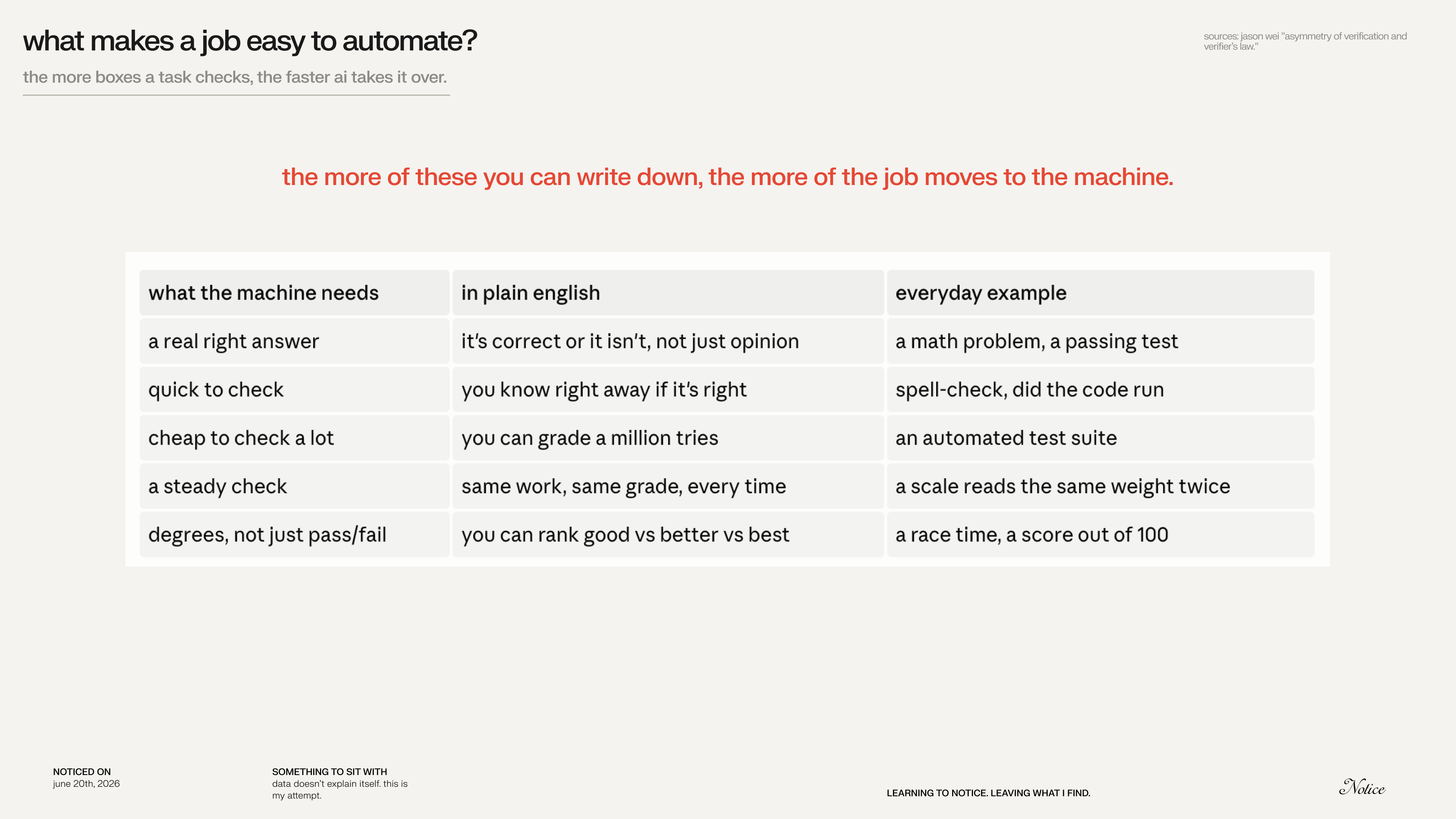
here’s the catch. doing the thing got cheap. so the hard part moved to checking it, and that’s where the money’s going now, more into building the answer keys than into the thing that does the work.
but checking is moving too. once the answer key exists, a machine runs it a million times without you.
so the hard part backs up one more step, to the part that can’t move. somebody has to decide what they’re after in the first place, and say it clearly enough to check against.
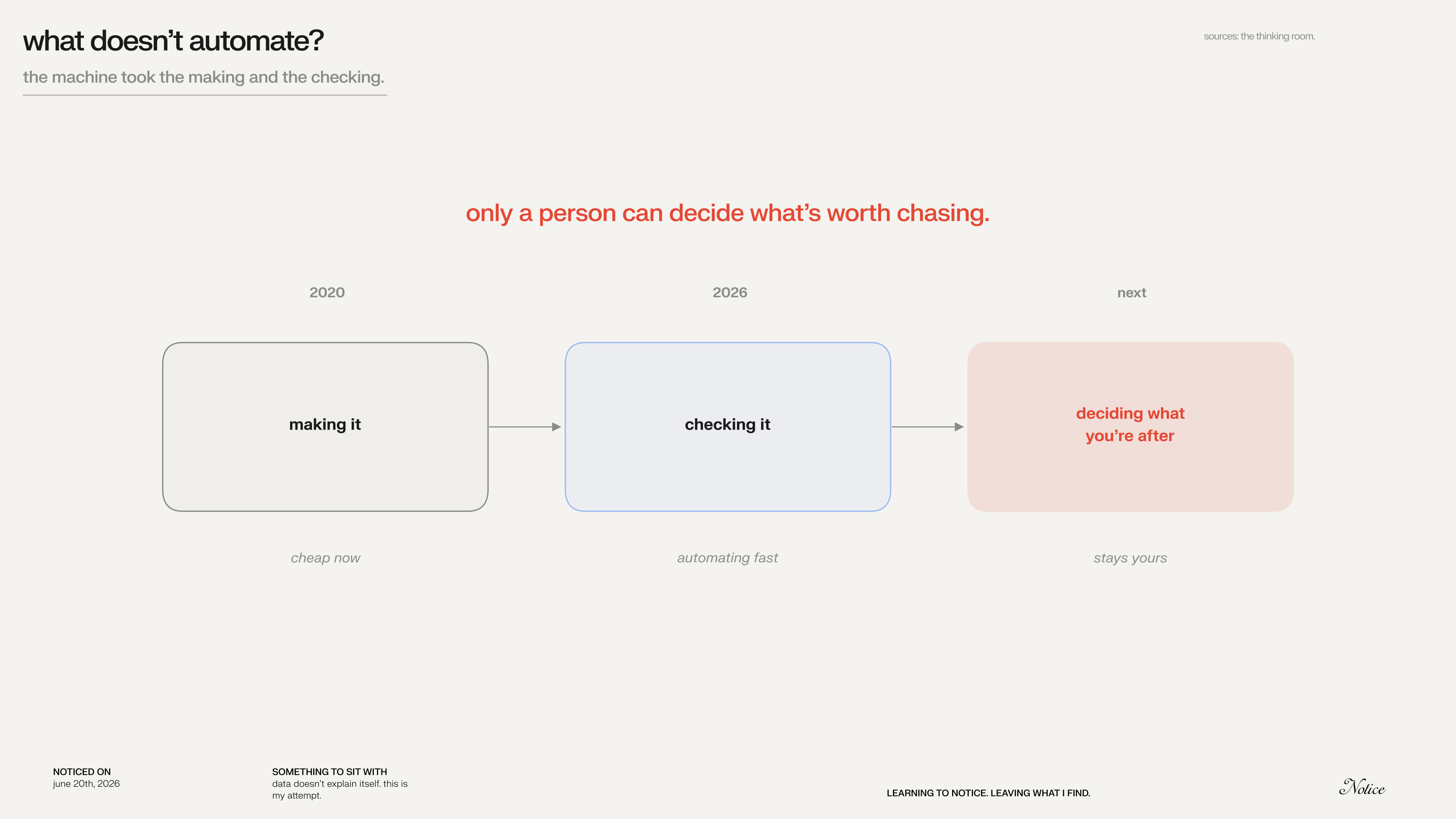
and some things you can’t even write a key for. is this a good poem. is this the right apology. is this person right for me. no money builds a key for those.
so the question quietly flipped. it’s not “how smart is it” anymore. it’s “what are you looking for?”
what i noticed.
so how does a machine actually get good at something. it practices. the labs put it on the practice field and let it try a task a thousand times, rewarding the attempts that go well. people call it reinforcement learning, but you already know it. it’s how a kid learns to ride a bike. wobble, fall, try again, stay up a little longer each time.
here’s the part that matters, though. all that practice is worthless unless the machine can tell when it got better. the bike teaches itself because staying up feels different from falling, the reward is obvious. once a machine can recognize success, it can practice forever, even invent its own drills, and blow right past us.
and that’s exactly where it breaks. out in the messy real world, it can’t tell a strong attempt from a weak one. was that a good apology. a good strategy. a good hire. so it stalls. same wall as before. no answer key, no progress.
which is why a whole industry sprang up to supply the missing answer keys, one task at a time. taste labs is the one that catches me. they’re trying to teach a machine taste itself, to bottle the one thing nobody can quite put into words.
how i’m seeing it.
this isn’t a fad. checking is a real new way machines get smarter, and it’s only getting stronger. it’s also not cheap. every new job is another practice field to build, with its own answer key inside, and something has to grade millions of tries. the practice is cheap. the checking is what costs, and the bill keeps running.
even robots learn this way now. jim fan at nvidia says they’ll fail a million times in a practice kitchen before they ever touch your real dishes. and it all rides on whether that practice kitchen can tell a good attempt from a bad one.
but the closer this gets to your real life, the more it runs into something it just can’t do.
think about dating. everybody gets an opinion. your friends can set you up. your mom can swear he’s perfect. the whole room can agree you two belong together. not one of them can choose him for you. they can’t sit in your seat. they can’t feel what you feel when you’re across the table. only you can.
one researcher put it plainly: you can hand off the doing, but somebody, somewhere, still has to say whether it was right. that job doesn’t disappear. it just moves up to you.
and underneath even that is the part nothing can touch. the machine can chase a target all day. it can’t pick the target. there’s a word for that. a spec.
so here’s the move, the thing you can start today. before you hand the machine anything, you write the spec. it’s just a few honest questions:
what am i actually after?
what does done look like?
what do i not want, the stuff that creeps in and ruins it?
who’s it for?
how will i know it’s good when i see it?
answer those, in writing, and you’ve handed it a real target. it runs and brings it back. skip them and you get slop, because that’s all you asked for. everyone else just types “make it nice” and hopes.
it’s the same list as that girl asking what i was looking for. i couldn’t answer it for my own life. no wonder i stalled on it for my work.
some lingering thoughts.
here’s the part i can’t shake. the one i haven’t seen anyone answer.
if the machine does the doing, where does the next person learn what good even is?
you don’t get taste from a book. you get it from doing the thing badly for years. the burnt dinners. the deals that fell through. the emails nobody answered.
so if the machine takes the reps, do we raise a whole generation that can run any tool but can’t tell good from average, because they never had to earn the difference?
i don’t know. but that’s the one i’d lose sleep over. not whether ai can write the email. whether anyone left can tell if the email is any good.
maybe that’s why so many people feel uneasy about ai. they think it’s coming for their work. sometimes it is. but the quieter thing is harder to admit. when the doing was expensive, you could hide inside the effort. look busy, stay in motion, call it a day. now the effort is basically free, and there’s nowhere left to hide from the real question.
you can hand off the doing. you can hand off most of the checking. you can’t hand off deciding what good means.
the machine can do almost anything now. it still can’t want the right thing for you.
so the future doesn’t belong to the people who can do the most. it belongs to the ones who can say what they’re after.
what are you looking for?
— brylan.