

everything gets cheap but you
a syllabus on intelligence getting too cheap to matter, and the one thing it can't touch. six things. two weeks if you do it right.

second pour.
no rush.
sit. stay a while.
open your feed and the story is that ai got too expensive. uber gave five thousand engineers claude code in december, burned the whole annual budget by april, then capped everyone at fifteen hundred a month. ninety-five percent of corporate ai pilots show no measurable return. i felt a smaller version of it myself last year, watching the perplexity and claude and cursor charges stack up, thinking is this even worth it.
here’s the strange part. at the same time, the price of intelligence is in free-fall. a model you’ve never heard of serves the same answer at a tenth of the famous one. so which is it, more expensive or radically cheaper?
both. and uber’s ceo said why in the same breath: “we use the more expensive models to explore. once we scale, we bring in cheaper or open-source ones.” that one sentence is the whole lesson.
the lesson this week.
the price of intelligence keeps falling. that part is certain. what’s not: cheaper has never meant less spending, it means more. so the market splits in two. the frontier keeps the work where intelligence still matters; cheap, good-enough models take everything else.
the syllabus.
six questions, in the order they come up. this isn’t a sitting. do one every couple of days and let it settle before the next, two weeks if you do it right.
i. why does ai suddenly feel too expensive?
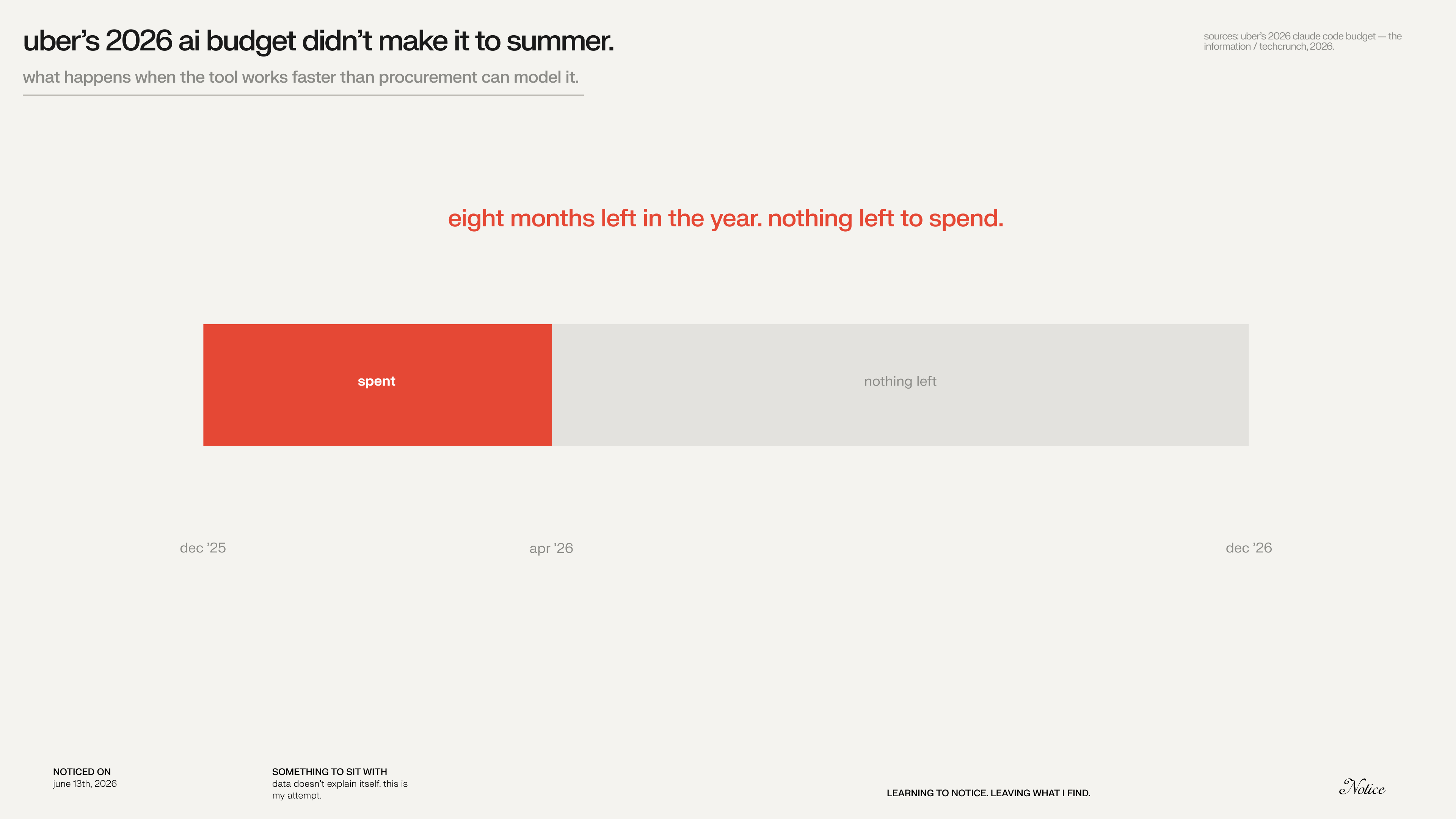
the bill is the problem, not the price.
start where the conversation is. uber gave 5,000 engineers claude code, usage doubled in two months, the budget was gone by april. on all-in, jason and chamath name the scary version: at three hundred a day per agent, the token bill starts chasing the salary. it feels like the bill is the problem.
the material.
things to notice:
the panic is about the bill (total spend), not the price (cost per answer). hold those apart.
uber didn’t quit. they capped it and kept going. the spend exploded because it worked.
sit with these. then take them to claude.
what do you pay for ai each month, and have you ever added it up the way uber just had to?
if the most disciplined operator in tech can’t scope its own ai bill, whose revenue model is underwater?
when the token bill passes the salary it replaced, what happens to that job?
ii. wait, isn’t it getting cheaper?
it is, faster than almost anything ever has.
now the other side. epoch tracks the two clocks: about 3x efficiency a year, and the cost to run a model at a fixed quality halving every two months. tunguz puts a face on it, deepseek cut training cost ninety percent and hit top performance at a fortieth of the price. his read on demand: it won’t shrink, “it’ll explode.”
the material.
things to notice:
the honest unit is price for a fixed level of performance. last year’s best is nearly free this year.
the cheapness is cleverness, not selling below cost. it’s real. (the frontier does the opposite, see v.)
sit with these. then take them to claude.
which ai task cost you real money last year and is basically free now, and did you re-price it?
if a fixed level of performance keeps getting cheaper this fast, whose pricing power is melting?
what becomes worth doing the moment it costs a hundredth of today?
iii. what are you actually paying the frontier for?
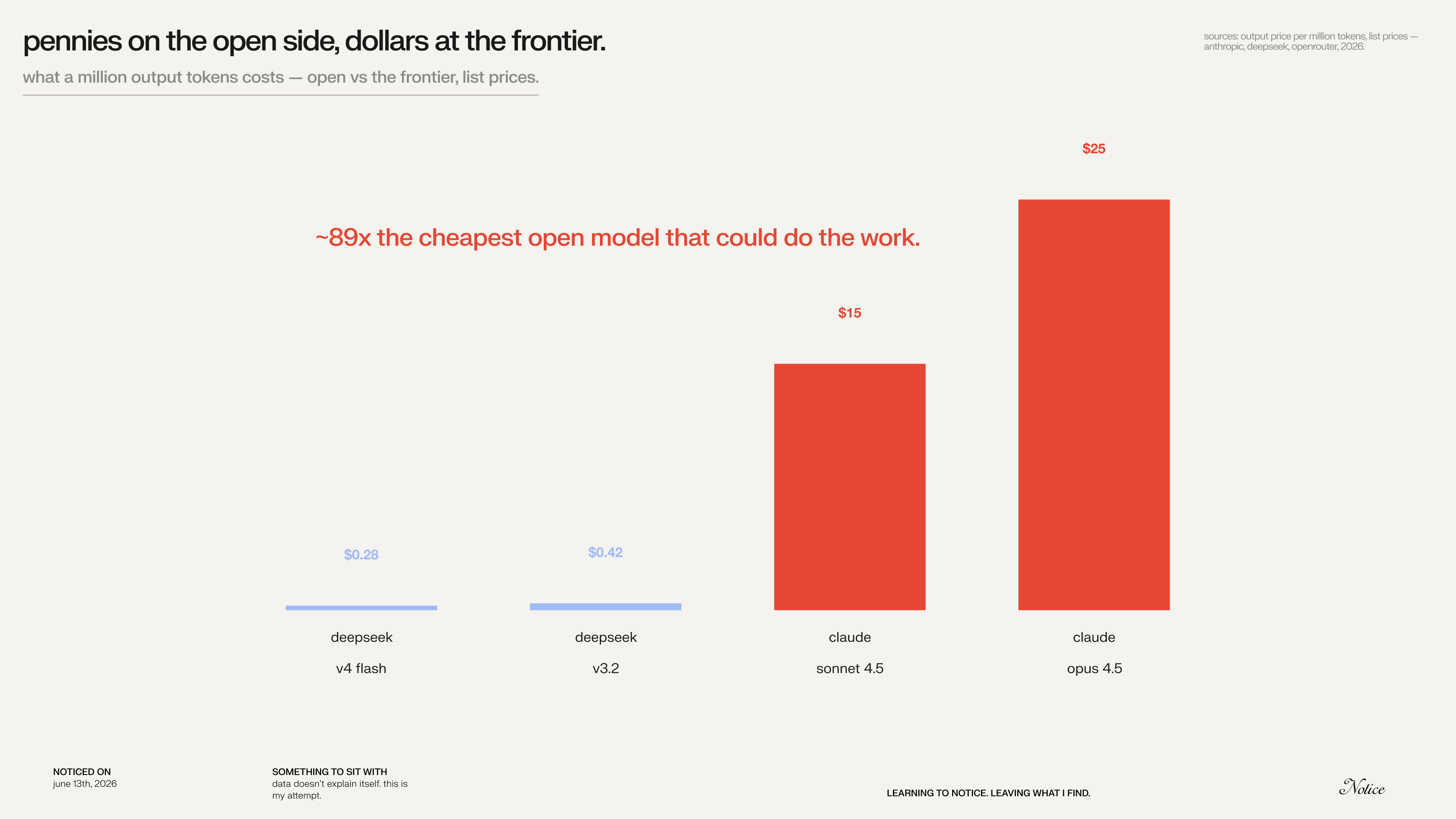
a four-month head start. that’s the whole premium.
this is where the lesson lives. epoch measures the gap between the best open and best closed model: about four months. yash patil, who built models at openai, says moving your real workloads to open weights is just a matter of time. openrouter shows how, swapping a frontier model for an open one cuts the per-token cost ten to fifty times. the split isn’t a prediction. it’s a config change.
the material.
things to notice:
the frontier’s whole premium is a four-month head start. for good-enough work, four months is nothing.
the gap is slightly widening (three months last fall, four now). bears see a moat (a four-month head start wins a winner-take-all race), bulls see a rounding error (nothing, for good-enough work). which read is right depends on the game you’re playing.
sit with these. then take them to claude.
what do you still pay a premium vendor for that an open model now does at a tenth, trust or inertia?
if the model trends toward free, where does the money go, and who was just reselling it?
when frontier intelligence is a four-month-old free download, what’s the new scarce thing?
iv. why does cheaper make the bill go up?
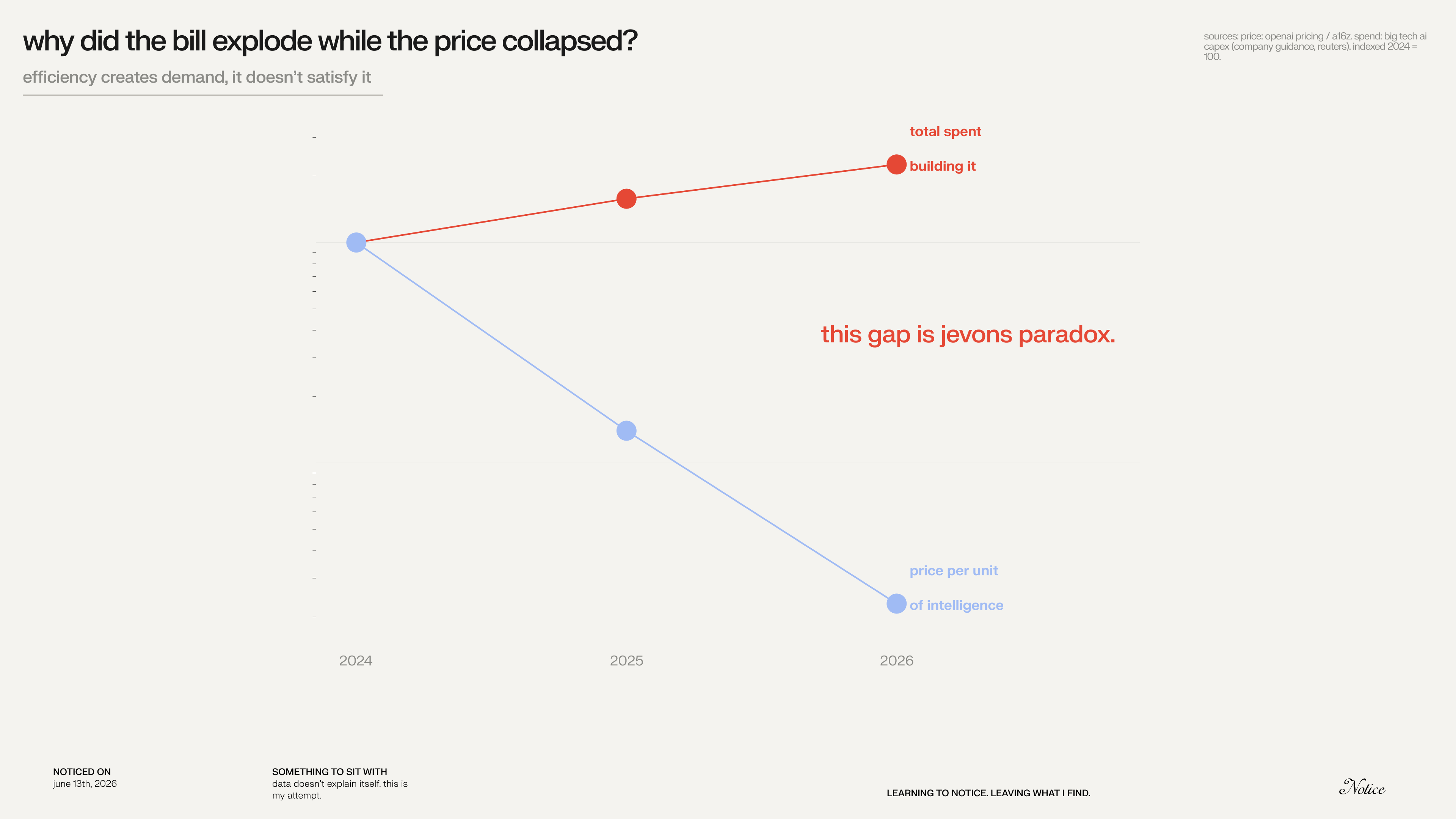
cheap wakes up demand that was asleep.
so why did the bill explode if the price collapsed? jevons paradox. when something gets cheaper, hidden demand wakes up and you use far more, not less. packy’s version is the clearest: cheap intelligence means more lawsuits, not fewer lawyers. better design demanded everywhere. that’s why cost-per-answer falling and the total bill exploding are the same fact.
the material.
things to notice:
efficiency creates demand, it doesn’t satisfy it. the most counterintuitive thing in the room.
jevons has a precondition: the cheaper thing must unlock real, productive demand. that’s the bet, not a law.
sit with these. then take them to claude.
the last time something got cheap for you, did you save the money, or use way more of it?
if cheaper ai means more total spend, who wins on volume even as prices fall?
what doesn’t exist yet only because the tokens still cost too much?
v. if it’s getting cheaper, why aren’t the returns showing up?
not yet, and the two ends are pulling apart.
the steelman. marcus stacks it: ninety-five percent of pilots show no return, uber can’t find proportional gains, “if enough companies admit the same, the story breaks.” then the same tunguz who told you the price would explode downward adds the sharp part: the frontier is getting more expensive. google tripling prices, opus at five dollars in and twenty-five out, because the cheap years were a subsidy that ends when margins matter. the two ends pull apart.
the material.
things to notice:
“the price fell” and “the economics work” are different claims. most noise wins the first and pretends it won the second.
watch the divergence: open gets cheaper, frontier gets dearer. two curves, opposite directions.
sit with these. then take them to claude.
of the ai you pay for, how much would you miss if it vanished, what would you defend with your own card?
if frontier prices rise while open prices fall, which side is each company you follow on?
when the subsidy ends, who’s left, the makers, the picks-sellers, or the ones built on top?
vi. what’s still scarce when intelligence is free?
you are. the human in the loop.
end on the deeper question, and the hopeful one. if intelligence gets nearly free, “too expensive” stops mattering, and what stays scarce starts to. imas and trammell work it out: when machines make most things abundant, human involvement becomes the scarce resource, the work where a person in the loop is the value. azeem points at the upside, cheap intelligence is an entrepreneurship boom, because a mediocre ai lawyer beats none.
the material.
dwarkesh × alex imas + phil trammell — what’s scarce after agi ↗ listen
azeem azhar — the ai boom is becoming an entrepreneurship boom ↗ read
things to notice:
when the input gets free, value runs to what stays scarce: taste, the human in the loop, the uncopyable.
the same cheapness that threatens the analyst is what lets one person start the firm. the floor drops for you too.
sit with these. then take them to claude.
what part of your own work would be worth nothing if a machine did it, where you are the point?
if intelligence is the free input, what scarce thing gets repriced up, and who owns it?
what would you build the day a team of ai workers costs less than lunch?
cheap is the easy part. it’s coming for everything, on a schedule, whether we’re ready or not. the part still open is what survives it. and this whole thing is named for the answer: when the intelligence is free, you’re what’s left. the taste, the trust, the read that can’t be downloaded. so don’t ask how smart the model is. ask which side each company builds on, and what it makes scarce on purpose. then go make yourself the thing that can’t get cheap.
— brylan.